| Home | Our Hope | |
| Bible Study |
|
January 8, 2025 |
| After Death | ||

Welcome to the After-Death study. This is a study that we have started doing every year because there are so many people who are interested in it, and the Bible has so much to say about it. What the Bible says, however, is spread all over the Bible. Unfortunately, it's difficult to put all the pieces together from the Bible, and so that's what we achieve here. Because there's so much of it, it's a difficult study to do as a whole, so we do it in pieces.
The study began with me reading the Bible and starting to recognize that the Bible described things after death that weren't what the church was teaching. These began to accumulate. The first time I presented anything along this line was in 2018, and it was only a one-lesson study at that time. But much, much more information was added as I kept reading and recognizing the differences. By the time it was presented in 2021, it was five one-hour sessions. Even more information has been added to it since then. So it would probably be six one-hour sessions now if it were to be presented in total.
Therefore, every year now, as we have been doing for four years, I take that big study and slice it differently, pull out a slice, and give it to you. Therefore, in this study, you aren't seeing anything close to the total amount of information.
This time, the slice of the pie is going to focus on the various destinations that people go to after death and the sequence of those transitions from one destination to another.
I'm going to begin this year's piece of the pie by introducing you to a concept you may not have heard before, the concept of a just-so story. I'll quote from Wikipedia about what that is.
A just-so story is an untestable narrative explanation for a cultural practice, a biological trait, or behavior of humans or other animals.
That's Wikipedia. My definition is a little different. A just-so story is invented to explain something, but it has little or no foundation in fact and so it is subject to change.
I have a quote from a professor, doctor James Tour, who uses that phrase in a video, a just-so story.
It's very hard for me to understand the chemistry on how you get massive body plan changes. Small changes occur all the time. Some people have used the term microevolution versus macroevolution, And they'll say, well, they're really one. This is a term that has been put by Christians.
No. Christians didn't use these terms. These terms came out from the scientific community. So you see the scientific community now evolving because what's happening. Very interesting. It's evolving because it used to be small gradual changes, [That] was what Darwin put. Then in 1972, Gould comes and he says, the fossil record doesn't show small gradual changes. You had punctuated equilibrium. You have now massive changes that occur very quickly in the fossil record, and then nothing happens. And then massive changes. This gradualism that Darwin had put is nonexistent, he said, in the fossil record.
So that changed in 1972. In my lifetime, in your lifetime, this has changed. So much so that geneticists today don't look at natural selection and mutation, the two fundamentals of Darwinism, as being the overriding concept. They will say that it is neutral drift, which is the small changes from me to my child to my grandchild, the neutral drift, and the idea of universal common descent. These have become the two pillars, universal common descent, neutral drift.
No longer natural selection and mutation. So what you and I were taught is no more taught. What is taught is two very different things. And so these folks have evolved.
And so I have sat with geneticists. Most people will not engage me on this because as soon as I start asking questions, what happens is their just-so stories start to wither. Biologists to me are the best storytellers in the world. How did that happen? Well, this happened. And I'll say, how could that have happened? Because chemically oh, yeah. Well, it it it it then probably this happened.
Woah. Woah. Woah. You can't just on a dime turn your story. This is a just-so story. You just exposed yourself. They have a story for everything. Every new piece of data, their story changes, which tells me this does not have a firm ground.
This is I think a key point and that is that very often what you get, are these biological, it might have been this or it must have been that or it could have been this, not necessarily supported by any empirical evidence. Right?
You probably know that I'm not bringing this up for no reason at all. I bring it up because there is a Christian just-so story, and it comes out of a core belief in Christianity. That belief is: after I die, I'll be in Heaven.
Now if that was actually in the Bible, anywhere, then there wouldn't be any reason to talk about this at all, but it isn't. This idea is not in the Bible any place, and therefore, a just-so story is needed to explain how that happens. And the just-so story goes like this: when people die, they immediately go to Heaven forever or to hell forever. You might think that's not much of a story. It's a one-sentence story. But it does get bigger, and I will show how it gets bigger when it's forced to change.
The point here is that this "when people die" story is a narrative created just-so the author can believe he is going to Heaven. That's what he wants to believe. He wants to have that. He needs to have this story because the "I'll be in Heaven" idea just isn't in the Bible. So he needs to create this just-so story. But the story isn't based on anything in the Bible.
Just as James Tour said above, it isn't possible to have a discussion with someone with a just-so story. I've tried this many times in the past. You can't have a discussion about the details because the person only cares about the "I'll be in Heaven" part. They don't care about the narrative story. They don't care about how it happens. They only care about I'll be in Heaven.
If you have a discussion with a person like that and you introduce biblical facts that test his narrative, the person is just going to change the narrative all by himself. He doesn't have to go through his pastor or anybody else. He doesn't have to check his Bible. He is just going to change the narrative. The universe shifts beneath your feet, and he doesn't care because the narrative never mattered.
Therefore any discussion with people like that becomes a chase after a moving target. You bring up a biblical fact to show them that something they believe is wrong. They just change what they believe, and now you have something completely different to shoot down. It's a story that keeps running all over the place, and you can never pin it down long enough to get rid of it.
I thought it would be useful to actually see an example of a discussion like that.
Bob: What happens to people when they die?
Tom: They immediately go to Heaven forever or to hell forever.
Bob: Who decides who goes where?
Jesus or God judges them.
Bob: But the Bible says Judgment Day comes at the end of everything.
Tom: I guess there are two Judgment Days.
Bob: Revelation says the people are judged and thrown into the Lake of Fire.
Tom: Okay. They go to hell and then later to the Lake of Fire.
Bob: What happens to people who died before Jesus' time?
Tom: Same thing. They are judged and go to Heaven or to hell and then to the Lake of Fire.
Bob: If they went to Heaven, then there was no reason for Jesus to die.
Tom: Oh, yeah. Jesus talked about a place called Paradise. They must go there.
Bob: What happens after that for them? How do they get to Heaven?
Tom: When Jesus died, he cut a path from Paradise to Heaven and took them there.
Bob: The Bible says Jesus went to hell when he died. How did he get to Paradise?
Tom: He decided to go there. He's God and he can do anything he wants.
Bob: After his resurrection, Jesus said he had not gone up to see the father. Why didn't he see him then?
Tom: I don't know. He didn't say.
Bob: Speaking of resurrection, the Bible says there will be a resurrection of dead believers.
Tom: Yeah, Jesus, the angels, and all the people in Heaven come down to Earth.
Bob: If all the believers went to Heaven when they died, who is left to be resurrected?
Tom: I guess the believers from Heaven go back into Paradise and are resurrected from there. Then they all go back to Heaven.
Bob: The Bible says they stay on Earth to help Jesus rule the Earth for one thousand years.
Tom: Okay. They rule the Earth then they go back to Heaven.
Bob: Paul the apostle said he expects to be in the place of the dead prior to the resurrection.
Tom: No, he didn't say that. Paul is in Heaven now.
Announcer: The questioner has been unable to make any progress in this discussion. It doesn't occur to the respondent that he has created a completely different narrative from the one he started with. This is because the narrative is not important to him. Only the idea that he is going to Heaven is important. For this reason, it doesn't bother him that he is making up stuff without the Bible's support. If he is asked again tomorrow, he will say that people immediately go to Heaven or hell forever.
So all of this brings up an important and obvious question. If everyone believes that they're going to Heaven when they die, but there's no support for that in the Bible at all, and they've created a just-so story to back it up, how is it that this idea got into the church? How is it that people came to believe this?
I would say 99-something percent of the people believe that they're going to go to Heaven when they die. And the church has believed that way for a very long time. The answer comes in the name of a person from the early Roman church.
His name was Justin Martyr. Now Martyr is not his last name. That's a title that's affixed to his name, "Justin". They didn't have last names back then. Justin was a significant figure in the early Roman church. He authored at least eight books. There are other authors of his time who talk about his books, but only three of those eight have made it down to our time. Here is a quote from one of those books, and it's relevant to what we're talking about here because he records the transition when the church was starting to believe the idea that they would go to Heaven when they died. This idea ultimately persuaded everybody, and everyone forgot what the truth of the Bible was. Justin says:
For if you have fallen in with some who are called Christians, but who do not admit this [truth], and venture to blaspheme the God of Abraham, and the God of Isaac, and the God of Jacob; who say there is no resurrection of the dead, and that their souls, when they die, are taken to Heaven; do not imagine that they are Christians (Dialogue. Chapter 80 - Justin Martyr - 110 AD - 165 AD)
It's a translation from Greek. It's not too bad, but it still needs a little explaining. I'll paraphrase what he says. He says, there are some people now who believe they will go to Heaven when they die. He's seen or knows of these people who make this claim in his time. But that wasn't the way things were, He says. Because they believe that they go to Heaven when they die, they don't believe in the resurrection of the dead in Christ.
That needs explaining too, but it's a big explanation that would be out of the scope of this study. The general idea is that throughout all of the New Testament, there are multiple references to the hope of the church being the resurrection, when Jesus comes. Thessalonians probably says it the most clearly. It says, when Jesus comes back, there'll be a shout, a cry, and a trumpet blast, and there will be a resurrection of those who are the dead in Christ. Justin continues and says these people are not Christians. This teaching that they believe, he says, is not a Christian teaching, and by believing it, they have rejected the truth.
Going back just a little further in history, we find Paul fighting against the idea that there is no resurrection.
But if the Messiah who arose from among the dead is preached [by more than 400 witnesses to Jesus being alive, including me], how are there some among you who say there is no life for the dead?" (1 Corinthians 15:12)
If those people also believed they were going to Heaven, I can't imagine Paul not also referring to that. But he doesn't. So, they seem to have exactly the same belief on this topic as the Sadducees had that Jesus contended against. What is Sadducee thought doing in Corinth, which is a long way from Israel? Obviously it had spread a long way. Perhaps these people had been Sadducees before they converted to Christianity, or had just picked up Sadducee thinking. Sometime later, it must have picked up the "going to Heaven" idea.
You might be wondering to yourself, does it matter? Who cares? Why does it matter that people believe the wrong thing about what's going to happen to them after they die? That's not a matter of salvation. And that's true. It isn't. But it's not a small thing. Throughout your life, any misunderstandings that you have are going to interfere with other understandings you're trying to add in that area. So if you don't understand part of something, it makes it harder to learn the next thing that you should be learning once you've understood the previous thing.
That's exactly the kind of problem we have here. Think of an example of an arithmetic expression, a very simple arithmetic expression.
X = 5 - 3 + 4
If you believe that addition should be done before the subtractions in an arithmetic expression like this, sometimes you're going to get the right answer, but sometimes you're going to get the wrong answer. That's because you've got a wrong idea about how things should be done. What makes it worse is that it doesn't always go wrong. Sometimes it's going to work right, and sometimes it's going to work wrong.
So, you just get confused and messed up about that, and it interferes with any more learning you want to do about arithmetic, geometry, or anything else that follows on after that.
We have an example of that from the Bible. The Bible says God took Enoch. It doesn't say he took him to Heaven, but almost everybody believes he went to Heaven. Where else could God take him to? He couldn't take him to hell. Everybody seems to believe that Enoch must have gone to Heaven, but this has an interesting contradiction with what Jesus said: "No man has ascended to Heaven."
You've got a contradiction now because you believe something wrong about what happens to people when they die. That's exactly the kind of problem we're trying to avoid here. Once you get this straight, other things get straightened out along with it.
So if the Bible doesn't say we go to Heaven when we die, what does the Bible say? The Bible says a lot about that. In this study, we're going to talk about the four destinations after death. These destinations and the transitions between them are shown in the diagram below. I'll discuss them more as we go along.

I'll start by talking about these blue bars. They represent realms or levels. The Bible doesn't call them that, but the Bible always says that Heaven is "up" from Earth. It never says you go down to Heaven. It always says up to Heaven. If someone goes from Heaven, they go down to Earth; it always says down for that. It never says beside or across.
This is the same with Sheol. We'll talk about Sheol in just a moment. It's at a different level, also. It's down from Earth.
Now Earth is a little different from Heaven and Sheol. It's a physical realm, and there are three levels within it. I simplified it in this drawing because it doesn't matter for this topic.
This is the flow of the transitions from realm to realm. We begin in the Earth realm as living beings, but then we die. When we die, the Bible says we go to Sheol.
Now if you don't know the word Sheol, that's an Old Testament Hebrew word. You can find it in many translations, but not most. It is used in the NASB translation and its variants, and in some others as well. Sheol is the Hebrew word for the place of the dead. Everybody goes there when they die. Good, bad, ugly, doesn't matter. Everybody goes there, no exceptions.
The very first thing that happens when you go there is that you're separated out. Jesus describes this in Luke, and we'll look at those verses later. There are angels there who are separating people into two different groups. There's the good group and the bad group, but this isn't a judgment. The people who are moved to the good group have something that identifies them. We'll talk about that something later. There's a divider between these groups, called a great abyss, that makes it impossible for people on one side to go to the other side. That's Sheol, and everybody stays there for some time.
The first group to leave does so at the Second Coming. Jesus is in Heaven until this time. At the time of the Second Coming, whenever that is, he comes down to Earth. Upon his arrival, there is an event called the resurrection. All of the people in Sheol who have that something, and have been separated into the good group, are resurrected into new bodies, and they go up to the Earth realm.
There's a judgment for this group at this time, but it is an odd judgment. The Bible says that everybody gets judged, the righteous and the evil. This judgment, though, is not what we would think of as a normal judgment. It's really just a declaration of innocence due to Jesus having paid for the wrongs that were done. It's basically Jesus saying these are my people. They trusted in me. I find them faultless, and they are justified, and therefore, they're good.
Then Jesus takes control of the Earth, and this begins a period called the Millennial Rule. That's a one-thousand-year rule where Jesus, with the assistance of the people who were resurrected, is ruling the entire Earth.
That lasts for one thousand years, and then comes what's called the Second Resurrection. The people who are still in Sheol are given some kind of body. We're not sure what. It's enough of a body that they can be judged because that's what is going to happen. Along with everybody who's left on Earth at that time, they are judged. As far as we know, all of those people go to the Lake of Fire. Perhaps there are some people who will be going to the New Earth and New Heavens. I'm not very certain about that one.
But this is really a judgment, like any courtroom kind of judgment. The people are judged by what they have done.
As part of the judgment, the Earth and the Heavens are renovated and are now called the New Earth and the New Heavens. The good people from Sheol who were resurrected into new bodies go there, and if any would survive the judgment of the others, they would go there as well. The Bible doesn't say a whole lot about this destination, but it says enough that we can get some idea of it. It is the eternal home of God's people.
So that is what the Bible says really happens. There isn't any going straight from Earth to Heaven. And in fact, the Bible never says anybody ever goes to Heaven. Maybe it's possible to go to Heaven for a visit or whatever, but the New Earth will be our home.
There is more to be said about the up and down that I mentioned before. At the start of the previous slide, I talked about realms. That's my own word. The Bible doesn't use any word like that. But the Bible does talk about places being up and down from each other. Realms is the best word that we have in English to describe that concept.
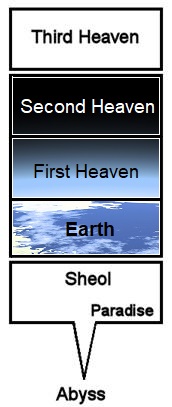
The Bible describes the whole universe as being a stack of realms, layers of realms all stacked on top of each other. At the top and the bottom, there are spiritual realms. You can see the separation between them in the drawing. As far as we know, it isn't possible for a human body, or anything physical at all, to be in the spiritual realms, either of those. It's only possible for them to be in the physical realms.
There are three physical realms. In the earlier illustration, I compressed them into one. There's Earth, which we know well. There's the First Heaven, which the Bible says is the place where birds fly. We might call it the atmosphere or sky. The Bible also talks about a Second Heaven, which is the place where stars, planets, and things like that are. We call that space. You're probably not used to the phrase Third Heaven, but the Bible does use that phrase. Paul uses that phrase, Third Heaven, and makes it clear that this is the place where God is. This is the spiritual realm where God lives. So this is the way things are, going upwards from Earth.
Starting from Earth and going down, we find Sheol. It is divided into two sides as I mentioned before. I didn't give names for the sides because the Bible doesn't. Jesus gives a name for one side of it as Paradise. I'm not sure that's really a name or a description, but either way, it works.
Sheol is split into two sides by the abyss that separates them. The people on one side can't go to the other side.
The Bible is very consistent with this up and down. It never says that Earth is above Heaven or that you go down from Earth to get to Heaven.
This helps us to understand some things in the Bible. One of those things actually is Elijah. The Bible says that Elijah was taken up to Heaven in a whirlwind. People want to believe he went to the Heaven of God. Now how would that be possible? A whirlwind can take you into the First Heaven, into the atmosphere where the birds fly, but a whirlwind cannot take you into the Second Heaven or into the Third Heaven.
The Hebrew word for Heaven that's used here is a plural form word, which means it can refer to a plurality of things or it can refer to a single thing among a plurality. So the exact same word can be used, and it can sometimes mean all three of these, or it can mean any one of these. So when it says Elijah went to Heaven, it's left to the reader to understand which Heaven is referred to. And as I just did, you figure that out from the context.
If they're taken up by a whirlwind, then the whirlwind couldn't have taken them out into space. Similarly, when you're on Earth, you can't go down to Sheol. The Bible actually talks about that idea of up and down in a verse from Amos that is on point for our topic because it uses both Sheol and Heaven in that way.
Though they dig down to Sheol, from there My hand will take them up; and though they climb up to heaven, from there I will bring them down. (Amos 9:2)
From that, you see really good examples that Sheol is down from Earth. Heaven is up from Earth. If you're up in Heaven and you're brought down, you're coming down to Earth. You see that up and down are consistently used throughout all of the Bible.
Now, an interesting thing about this is that you cannot move from these physical realms into the spiritual realms. There's nothing you can do. You can go out into space, go anywhere you want in space. You will never be able to get to the Third Heaven because it's a spiritual domain. Sheol is the same way. The verse says, "If you can dig down to Sheol," but it doesn't mean that literally. It's figurative. You can dig all you want into Earth, and you're never going to get to Sheol. Well, you might. If you get down to where the lava is and it kills you, yeah, then you're going to Sheol. But that's the only way you're going to go from Earth down to Sheol, by digging.
So it's important to understand this layering of realms because an incomplete understanding can cause you to misunderstand what the Bible is saying many times.
Our focus is on destinations, and the first destination we're going to look at is Sheol. That's a word that very few Christians know of, even though it's used heavily in the Old Testament. We'll talk about why that is later.
Sheol is the place where everyone goes when they die. It doesn't matter how they've lived in their life, everyone goes to Sheol. Our best evidence about what Sheol is like comes from Jesus. He gives a long description of this place. In most translations, though, you're not going to see the word Sheol used. You're going to see the word Hades used or the word Hell used, or some translations just say "place of the dead". We won't get stuck on the words "Hades" and "Hell" and what those mean and where they come from.
Jesus describes people dying and going to Sheol and their experiences there. It's important to understand that Sheol is a spiritual realm. It's a place of spirits. As people who live in the physical realm, we don't understand what a spirit is, so we can't really understand Sheol. Jesus sometimes engages in some metaphorical descriptions to help us sort of get an understanding of what it'd be like.
His purpose is to give us as much of an understanding as we can have at this time, but we can't have a complete understanding of all of it. This comes from Luke 16. I'm going to start with verses 19 through 21, comment on that, and then finish it.
There was a certain rich man, and he wore fine white linen and purple and everyday he celebrated luxuriously. 20 And there was a certain poor man whose name was Lazar (Lazarus in other translations) and he lay at the gate of that rich man, being stricken with abscesses. 21 And he longed to fill his belly with the fragments that fell from the rich man's table, but also the dogs would come licking his abscesses. (Luke 16:19-21)
But that poor man died and Angels brought him to the Bosom of Abraham (That's a metaphorical description). And the rich man also died and he was buried. 23 And suffering in Sheol, he lifted up his eyes from afar off and he saw Abraham, and Lazar in his bosom. 24 And he called in a loud voice and he said, "My father, Abraham, have pity on me and send Lazar to dip the tip of his finger in water and moisten my tongue for me; behold, I am suffering in this flame." 25 Abraham said to him, "My son, remember that you have received your good things in your life and Lazar, his evil things, and now, behold, he is comforted here and you are suffering. 26 And along with all these things, there stands a great abyss between us and you, so that those who would pass from here to you are not able, neither is whoever is there able to pass over to us." (Luke 16:22-26)
You see the mention of this chasm, which is "abyss" in some other translations. The word "pit" is used in some translations. It's a division between the sides that no one can get over, except the angels.
From what Jesus says and also with a little thought, we can tell quite a bit about what existence there is like. An important thing to understand, I think, is that no one there has a body. We can barely fathom the concept of not having a body because our lives are so integral with our bodies. But without a body, it makes sense that there would be no perception. Having no eyes, ears, or nose means you can't perceive anything. It may seem like the people in this story are perceiving things, and they're communicating and doing other things. That's part of the metaphor.
There would also be no movement, no legs, no arms, no way to get around. There would be no communication, despite it seeming like they're communicating because there are no mouths to speak, no hands to sign, nothing like that for communication. More importantly, they would have no mind. The place where you think your thoughts no longer exists because that's part of your body. There would also be no personality. Your mind and your personality are actually part of your physical body. When that dies, those are gone. That's just beyond us to fathom. We can't even think of what an existence would be like that.
The discussion between them is about this water that the rich man needs, and that he knows Lazarus has. He's trying to get it because he's burning up, and he knows he needs this water to cool him down. We'll call this water the Water of Life, and we'll explain that later.
What do the people there have? They have a knowledge of who they are, and who they were, when they were alive. We see that through what the rich man says later in the story. I left out those verses because they're not exactly related to what we're talking about. You can read that yourself. You can see from his discussion that he knows who he was when he was alive. He knows he had a family and he still cares about them. He also knows or has memories of all of the things that he did, very clear memories. Not the fog of memories that we have now. He has a clear recollection of everything that was done in his whole life, which is not something that we have now. We have bits and pieces of memories that get worse and worse over time. He also has a knowledge of God's standard, and that's the cause of his suffering.
He knows that the life he lived isn't acceptable according to that standard. In the verses I didn't include, he talks about the need to make sure that his brothers hear God's word so they don't suffer in Sheol.
We've seen so far that the rich man in Sheol is suffering in torment and needs this water. We've also seen that he knows that Lazarus has this water, but we don't know what this water is, and we don't know what the source of this water is.
Jesus speaks about this. In John 4, he says:
Yeshua answered and said to her, "If only you knew what the gift of God is, and who this is who says to you, 'Give me to drink', you would have asked for what he has, and he would have given you living waters." (John 4:10)
In a Christianity that believes that you're going to Heaven as soon as you die, this water of life, the living waters that Jesus is talking about, has no value at all, and people know nothing about it. But here, in Sheol, it does have a value. Jesus speaks about this living water again in John 7. He says:
Everyone who trusts in me, just as the scriptures have said, rivers of living water shall flow from within him. (John 7:38)
Revelation also speaks of this water of life. It calls it the same thing - living water.
And he said to me, "They are done. I am Aleph and I am Tau, the source and the fulfillment. I shall give to the thirsty one from the fountain of the water of life without charge." (Revelation 21:6)
So again, the water of life is a promise in the future.
We saw above that Jesus spoke about "scriptures". The New Testament didn't exist yet, so that means the Old Testament. He is saying the Old Testament said this in the past. Do you remember that? Probably not.
For My people have committed two evils: (this is of course God speaking) they have forsaken Me, the fountain of living waters (He means, I am the fountain of living waters), to hew for themselves cisterns, broken cisterns that can hold no water. (Jeremiah 2:13)
We won't go into the depths of that verse, but it's actually quite significant. We see in all these verses that the source of the water of life is Jesus, and the water has a purpose. In Sheol, it gets rid of the burning that is the rich man's fate.
Here's the part that surprises everybody. Our bodies, while they are alive, have the water of life in them. We know that from something Jesus says. Prior to these verses, Jesus has been casting spirits out of people. A little bit later, he talks about what happens when a demon is cast out.
But whenever a foul spirit goes out from a man, it wanders about in places without water in them, and it seeks rest and does not find it. 44 Then it says, "I shall return to my house from where I came out" (Matthew 12:43-44)
When the spirit says "my house," he means where I was before, the man that I lived in before. So the foul spirit, also called a demon, wants this water. He himself, a demon, has a need for this water. If he doesn't have that, he wanders about in places without water, looking for it. Our point here is that the demon had that water while he was in that man. Once he was kicked out of that man by Jesus, he doesn't have it.
We see that living water is in a human body, but that would not be physical water. We don't know what it is, but whatever that water is, bodies have it. When a person dies, of course, the water in the body is gone. It's of no use to the spirit that departs the dead body.
The bodies we live in are amazing things, but I mean that in a different way than you've probably ever thought of it before. We have the ability to make up a lie, tell ourselves that lie, and then believe that lie. That's just amazing. You would think that's psychotic if you really thought about it, but we have that ability to do that and we use it. Maybe if we've said something horrible to somebody else, we'll say to ourselves, well, that person deserved it. If we stole something, we'll say, well, I deserve that. It should be mine. We make up these lies because we feel guilt about it, but we get over that with time and with this lie, and then we're good. It's really part of human nature to do that.
But in Sheol, it's not that way. The spirits there know they've lived a life that doesn't meet God's standard, at least for those who are on the wrong side of Sheol. They understand all of this with exactness and with a clarity that they've never known before. When the body was stripped away, all of the lies and forgetting were stripped away. Now all they have is the truth, the pure unvarnished truth as they say.
With nothing but memories of failures, those people who are on the bad side experience torment. You can think of it in your own life. Have you ever done something so bad that it really hurts you to think about it? Whenever you remember back to having done that, it hurts. It almost burns like fire.
Sheol would be all of that and even worse than that. We have that water of life that gives us some ease from that fire of torment that we should be in. We also forget over time. The things we've done aren't always on our mind. In Sheol, people need another source of this water and they need it badly. We talked about where that comes from and how it won't be coming to those who didn't trust in Jesus.
We need to look at part of Luke 16 that we've already looked at.
[the rich man] called in a loud voice and he said, "My father, Abraham, have pity on me and send Lazar to dip the tip of his finger in water and moisten my tongue for me; behold, I am suffering in this flame." (Luke 16:24)
It says he called in a loud voice. In another place, it says he looked up. So it seems to imply that he has eyes and a voice, but this is only for the sake of this metaphorical story. It is very common in prophecies to do this. God has chosen to have characters in prophecies, which are metaphorical stories, to often speak out the story elements. So instead of having an announcer telling the story, the characters themselves will speak words that tell us parts of the story from their perspective. That's what we're seeing here. It isn't something unique to this story.
We're hearing this story about how this man needs this water, and he knows that Lazarus has it. The announcer could say, "The rich man called out to Abraham," instead we hear the rich man, "My father, Abraham, have pity." That's a more gripping way of telling the story. That doesn't mean the spirits in Sheol can speak.
Near the start of this study, I mentioned that when people died, there were angels who separated them into the two different sides of Sheol. At that point, I only said that some of the spirits had something that the angels could see, and that was how the angels knew how to separate them. Now you know what that something is. The angels can see that, or the lack of torment.
This is the verse that talks about that separation.
But that poor man [Lazarus] died and angels brought him to the Bosom of Abraham. (Luke 16:22)
You can see this isn't a judgment. This is simply the angels doing a job they've been assigned. They see the people come in. They can see the ones with the water are smiling and cool and chill and everything's fine.
There are some other comments I want to make about this verse. It's a metaphorical story, and so we see the bosom of Abraham mentioned here. Other verses in this context also mention Abraham. At the time Jesus tells us this story, Abraham has died, and he is in Sheol. That's true. But the Abraham that you see referenced here is not that Abraham. This Abraham and his bosom are symbols in this metaphorical story.
They symbolize, for Abraham, the Abrahamic covenant. His bosom symbolizes the comfort and the water that comes with that covenant. Those people who have accepted the Abrahamic covenant, we're talking Old Testament people, also get the water. That's part of the metaphorical nature of this story, and I wanted you to understand that.
I also wanted to say something similar about Lazarus. Lazarus is basically an NPC, if you know the gaming world, and honestly, I don't. He's a non-player character. He's referred to or referred about, but he doesn't speak. He doesn't do anything. He just sits and rests in comfort, and he's chilling out, I guess. He doesn't really have a role in this whole story.
The next destination I want to talk about is Earth during the Millennial Rule.
If you remember back, the Millennial Rule will begin when Jesus comes down from Heaven in what's called the Second Coming. For those 1000 years, He's on Earth. The people who were on the good side of Sheol have been resurrected, and they're back on Earth in new bodies, spiritual bodies, not physical bodies.
The Millennial Rule occurs on the planet Earth, but it will be an Earth like we've never seen before, one we couldn't even imagine before. Currently the Earth has only human beings on it. They might be tall or short, skinny or fat, but they are all flesh and blood human beings. It won't be that way then. There will be:
The resurrected people, the spirit people, will be helping Jesus run the world. It makes sense that the angels would be on Earth, doing the same sort of things as the resurrected people.
The government will be utterly different. We now have no world government. Each country has its own government. Because of that, there are often disputes and wars. None of that will happen anymore.
Under Jesus' direction, the spirit people and possibly the angels, if they're there, are going to be doing the teaching and enforcing of the law and making sure that people live the way they should. Sinning will not be an option anymore. The Bible tells us very clearly about that. There is going to be very direct teaching. God speaks through Isaiah, first to the Jews of Isaiah's prophecy, then he switches to speaking about our future.
The Lord has given you bread of distress and water of oppression; (here's the switch) He, your Teacher will no longer hide Himself, but your eyes will see your Teacher. 21 And your ears will hear a word behind you, "This is the way, walk in it," whenever you turn to the right or to the left. (Isaiah 30:20-21)
We're seeing the spirit people, and possibly the angels, will be there teaching people how to live. Whenever they're about to make a mistake, the spirit people will appear and teach them, "No. Don't do that. Here's the right thing to do."
There's also going to be an enforcing element for those who don't seem to be getting the picture. Revelation talks about that. This phrase used here, "shepherd them with a rod of iron," also appears in the Old Testament.
To him who is victorious and keeps my works, I shall give authority over the nations, 27 to shepherd them with a rod of iron, and like the vessels of a potter you shall shatter them, for in the same manner I have also received of my Father. (Revelation 2:26-27)
The last part there is saying that I, Jesus, was given the authority to rule over the nations and I give that authority to the people who were victorious and kept my works. This authority includes doing what is necessary, a rod of iron, unforgiving.
It will not be acceptable to sin. How that will work is not clear, but we get the idea. It won't be possible to sin. That will make a massive change in society. The inability to do evil to other people and to do evil generally, makes for a completely different Earth. Nothing will work the same as it did before.
There will be a temple for the ordinary people. A temple is a strange idea to us in Christianity, but the temple that was in the Old Testament is going to be rebuilt again, during this time. We know that will happen because Ezekiel spends about six chapters of his book describing, in very deep great detail, everything from the size of the large complex, to the heights of all the buildings, to the width of the doorways and what they're made from. We could build it right now, based on Ezekiel's description, if we wanted to.
It's going to be built in Jerusalem, but Jerusalem will also be a very different place at that time. The ground in the Jerusalem area is going to be flattened out and changed in a massive way. The Bible talks about that. That makes it possible for this temple to be a much larger complex than any temple before it. But it will be in that area.
One question that people always have is, why would there be a temple? We don't need a temple right now as Christians. There's a good reason for that. The Holy Spirit will no longer be available to ordinary people at that time. That seems strange to us, but it's true. When you think about it a little bit, it makes sense. But I'm not going to go into any detail on that right now. I've covered that before in other lessons.
With the Holy Spirit no longer being available to ordinary people, they have to revert to the temple worship style that was in the Old Testament, and therefore, that's necessary again. That will be restarted in this new temple building that will be built.
What we've seen here so far are the primary changes that we know about from prophecy. Those result in a whole bunch of secondary effects that would happen.
Massive changes in society worldwide are going to happen. There won't be any war anymore. That simply won't be allowed to happen. Almost from the beginning, mankind has wanted to and tried to put an end to violence and war. That was never possible due to the limitations of mankind. Now it becomes possible. If you can be sure there will be no more war, there's no longer a need for armed forces, no longer a need for all the military suppliers who build things for the armed forces. Right there, that's a huge weight taken off of society.
There will also be no crime. So no police forces are necessary. No courts are necessary. No jails or prisons. No people losing time in jails and prisons, losing big chunks of their lives because of the things that they've done. Society overall becomes much more productive.
There are many things in our lives that we have to pay for again and again, that we won't have to pay for anymore. I'm thinking of insurance generally, but let's look at theft insurance specifically. You might not have thought of that one. If there won't be any theft, you don't need that kind of insurance anymore. No locks on doors. You wouldn't need to put a lock on a car door or a house door because nothing is ever going to happen that would be able to cause you any loss or injury.
There would be no need for fear of loss or injury. That is an important change, too. We would no longer have to fear any of the bad things that might happen now in our lives because those things won't be allowed to happen.
You can see the big changes, and even bigger than I've described here. If you think about it more, society would be unrecognizable.
The next destination I want to talk about is called the New Heavens and the New Earth. That's the name the Bible uses to refer to it.
This destination begins with Judgment Day. This is the real judgment. This is when people are brought before God and he judges them one by one and separately. That judgment results in two different things, some people going to the Lake of Fire, that's the next destination we'll talk about. The others go to the New Earth and the New Heavens.
So how does this New Earth and New Heavens come into being? We know very, very little about this. There are only two passages in the Bible that talk about it, and they describe it in different ways. We know the current Earth and Heavens are gone at the same time the New Earth and New Heavens appear. Peter talks about it using words like fire, dissolved, and melting. He talks about it as a real physical reconstruction of the old into the new. Revelation talks about it in more symbolic ways, as you would expect Revelation would do. It uses words like departed and arrived.
While you expect and eagerly desire the coming of the Day of God in which the Heavens, being tested by fire, shall be dissolved, and the elements (which means the Earth), when set on fire, shall melt. 13 But according to his promise, we look for the New Heavens and the New Earth, in which dwells righteousness. (2 Peter 3:12-13)
He sees it more as a real physical process being applied that renovates or changes the Earth into the New Earth and the Heavens into the New Heavens.
And I saw New Heavens and a New Earth, for the former Heavens and the former Earth had departed. (Revelation 21:1)
That's a very different view of it. Revelation is all about metaphor, so we should not be surprised by this difference.
I think it's a renovation, and Revelation is describing it as departing and arriving in the same way that the Earth was destroyed in the flood. After the flood, everything was different. The land masses had moved around, their surfaces were scrubbed flat and then reformed, and the water layer above the earth was gone. It would be easy to say, especially when using poetic phrasing, that the pre-flood world had departed. All we do know for certain is that we start with the Earth and Heavens that we currently know, and we end up with these New Earth and New Heavens.
What is the purpose of this renovation / replacement? What is the need that makes it so important that the whole Earth must be dissolved like this? What is the driving force here? What is God trying to achieve? Why are the current Earth and the current Heavens not sufficient at that time, that they need to have this renovation?
Especially in Revelation, we see that the use of the words New Earth and New Heavens means more than places. A physical Earth, yes, and a metaphorical Earth, which is God's people. Likewise, with the New Heavens, it sees that as a reference to two things as well, the spiritual Heaven and the metaphorical Heavens, which are God's angels.
Why would it refer to places and people like that? The purpose of Judgment Day is to remove evil from God's creation. The evil people are removed to the Lake of Fire, but that isn't enough. All traces of evil are being removed from everything and everyone. In the New Earth and New Heavens, there will be no evil at all. Even the memory of those evil things that we had known when we were ordinary people is being removed. Even the evidence that exists in the Earth of the evil that was done and of the evil people who were there before, all of that is being removed too.
By the time we get to the New Earth and the New Heavens, there will be nothing evil. More than that there would be nothing to make us think that evil once existed, There would be nothing that we would ever be able to find and pick up and say, "Oh, look, this is from some previous age where there was something evil." All of that will be gone. There will be no taint of evil in the New Earth or New Heavens at all, just as it was after creation.
We do know quite a bit more about the New Heavens and the New Earth after the renovation. Revelation talks to us about that, and there are even passages in the Old Testament that talk about that period of time.
And I saw new Heavens and a new Earth, for the former Heavens and the former Earth had departed, and the Sea was no more. 2 And I saw the holy city, New Jerusalem, descending from Heaven from beside God, prepared like a bride adorned for her husband. 3 And I heard a great voice from Heaven that said, "Behold, the Tabernacle of God is with the children of men, and he dwells with them and they shall be his people and the same God is with them and shall be their God. 4 And he shall wipe away every tear from their eyes, and from now on there shall not be death, neither grieving, nor clamor, neither shall there be disease again, for His sake." (Revelation 21:1-4)
Notice that the holy city, the city of God, New Jerusalem, descends from Heaven down to the Earth. That's the consistent up and down that I've mentioned.
I'm going to skip ahead now in Revelation to where it talks more about the city, and then it goes on to talk about some other things about what life and existence would be like then.
And [the city had] 12 gates and 12 pearls, one to each, and every one of the gates was of one pearl, but the street of the city of pure gold, as if there was glass in it. 22 And I saw no temple in it, for the Lord Yahweh God Almighty, he is its temple. 23 And the Lamb and the city do not need the Sun or the Moon to illuminate it, for the glory of God illuminates it, and the Lamb is its lamp. 24 And the nations walk in its light and the Kings of Earth bring glory to it. […] 27 There shall not be anything defiled there, or one who makes defilement or lies, but only those who are written in the Book of the Lamb. (Revelation 21:21-24,27)
If you've ever heard about Saint Peter at the pearly gate, as the doorkeeper or gatekeeper to letting people in and deciding who gets to go into Heaven, this is the only place in the Bible where gates of pearls are mentioned. In the city of New Jerusalem that was described earlier, there are 12 gates, and each one is made of a single pearl. There is nothing about Saint Peter, and this is the city of God that comes down to Earth. It is not in Heaven. Nobody goes into it until it gets down to Earth, which will be its home.
Notice the lack of defilement that I mentioned before. Nothing evil or defiled will exist there.
Skipping ahead in Revelation
And no curse shall be there, and the throne of God and of the Lamb shall be in it, and his servants shall serve him. 4 And they shall see his face and his Name shall be upon their foreheads. 5 And there shall be no night there and neither will they need lights, lamps, or the light of the Sun, because the Lord Yahweh God gives them light, and he is their King for the eternity of eternities. (Revelation 22:3-5)
The phrase "eternity of eternities" means "forever and ever", "endlessly".
How would we see here? That's an interesting question. There's no night, and there's going to be no need for lamps or the light of the sun or anything like that. There was another earlier reference that we said there was no need for the Sun or the Moon. It seems that the renovation of the New Earth not only resulted in a New Earth, but also in a new universe. Would there be no sun, no moon, no planets, no stars, nothing like that? We can't say for sure. It's clear that the light we would experience would not come from those.
The next and last destination is the Lake of Fire. The Lake of Fire is more of a descriptive name than a real name of a place. I'll say more about that later.
I've said already that on Judgment Day, the remainder of the people who are in Sheol and the ordinary people alive on Earth are judged. Maybe some of those will be found justified, but the vast majority will go to the Lake of Fire. I left out something and left it off the diagram as well, so I'll go back and cover it now. There are already a few people in the Lake of Fire at the start of Judgment Day. As the Millennial Rule began, 1000 years before Judgment Day, a few people were thrown straight into the Lake of Fire. It seems like the Lake of Fire only comes into existence at this point in time.
The ones who were already in the Lake of Fire are there because they have been so bad that they have to be dealt with right away. They are called the Beast and the False Prophet in Revelation. The Beast is better known as the anti-Christ and his organization. The False Prophet may only be a single person, but could also be an organization. The first ones in the Lake of Fire could be a few people, like only the leadership, or they could be everybody who's formally in that organization. The Bible is a little fuzzy there.
And the Beast was captured and the False Prophet with it, who did signs before it by which he seduced those who received the Mark of the Beast, and those who worshiped its image; and both went down and were cast into the Lake of Fire that burns also with brimstone. (Revelation 19:20)
So when Jesus came, one of the things he did was to collect these people who had been busy massively deceiving people into doing what's wrong. Among other things, they've been convincing weak Christians to receive the mark of the Beast.
Another is sent to the Lake of Fire before Judgment Day begins, but this one comes just before Judgment Day, after the Millennial Rule. It is Satan. He is sent there because of all that he has done, beginning in the Garden of Eden, but most recently, he has started a revolt of mankind against God. He convinced them that the perfect world without war, violence, or crime was not what they wanted.
And their Seducer, the Devil, was cast into the Lake of Fire and Brimstone where the Beast and the False Prophet are [already], and they shall be tormented day and night for the eternity of eternities. (Revelation 20:10)
That's everyone who goes into the Lake of Fire prior to Judgment Day. That's the Beast organization with its leadership, the False Prophet, who is the leader of his organization, and possibly parts or all of their organizations.
After that, there's a general judgment of everyone else, called Judgment Day or the Great White Throne Judgment.
And I saw a Great White Throne and him sitting at the top of it, from whose face Earth and Heaven fled away, and no place was found for them. 12 And I saw the dead, great and small, who stood before the throne, and scrolls were opened, and another scroll was opened, which is of the judgment, and the dead were judged from those things that were written in the scrolls, according to their works. 13 And the Sea yielded the dead which were in it, and Death and Sheol yielded the dead which were with them, and they were judged, one by one, according to their works. 14 And Death and Sheol were cast into the Lake of Fire - this which is the second death. 15 And whoever was not found inscribed in the Book of Life was cast into the Lake of Fire. (Revelation 20:11-15)
We've looked at Earth and Heaven departing (fleeing) already. As I said, this doesn't sound like renovation, but if we look closely at the wording, it says, "fled … from his face." This means they were full of evil. It doesn't mean that the Earth and Heavens are able to run away from God. So this is poetic language. I think it is meant to convey the need for renovation, which happens during the judgment.
Death seems like an abstract idea to us, something that could not be destroyed. Although Sheol is a place, it's a spiritual place that you wouldn't think could be destroyed. The verse talks about Death and Sheol being cast into the Lake of Fire, which really means the end of those. They don't exist anymore after this.
It turns out that Lake of Fire is not so much a description of a place. This "place" is described in three different ways in the Bible. The Lake of Fire name is a description of an experience. There's another description that speaks about the eternality of that experience, the duration of it, how long it lasts. Then there's another description that speaks about the "where" of it.
Thinking back to the story of the Rich Man and Lazarus, we saw the rich man saying that he was suffering in flames. We understood that that was a personal experience for him. He wasn't burning away in flames that were on the outside of him. These were flames that you would say are on the inside of him.
So if you take a bunch of people who are suffering in flames like the rich man, and you put them all together in one place, what do you have? You have a Lake of Fire, if you can see it that way. If you put enough drops of water in a depression on the land, it becomes a lake of water. Thus, the gathering together of all of these people creates the Lake of Fire. So it's not so much a place as something that is created by grouping people together, making it a place by having people there.
The second description I talked about, the one that talks about the duration of it, that one comes from Mark. It's described as a worm that always eats on the dead. Now we need to understand a little bit about the allusion here because it's not part of our society. On a battlefield in the past, all the bodies of the people who had died in the battle were put into a pile and burned. Sometimes, they were just left, if there wasn't time to do that. Worms would come out of the bodies and eat them up over a long period of time. That's what Mark is referring to: worms that never stop eating on this pile of dead bodies. He repeats this 3 times.
Where their worm does not die and their fire is not quenched. (Mark 9:44,46,48)
He's talking about the same place. We know that because he is also talking about a fire that does not go out. This doesn't mean there will be worms in the Lake of Fire. Mark's focus is on the idea that it never ends. This experience goes on, and on, and on.
The second description I talked about talks about the "where" question. It uses the phrase "outer darkness". I alluded to this at the very beginning, in the drawing of the levels by placing the Lake of Fire outside of the normal levels. So the outer darkness indicates an outsideness of everything.
But I say to you, that many will come from the East and from the West and will recline with Abraham and Isaaq and Jaqob in the Kingdom of Heaven. 12 But the children of the Kingdom will be cast out to outer darkness; there will be weeping and gnashing of teeth. (Matthew 8:11-12)
And he said to him, "My friend, how did you enter here when you did not have a wedding garment?" 13 Then the King said to the attendants, "Bind his hands and his feet and cast him out into outer darkness; there will be weeping and gnashing of teeth." (Matthew 22:12-13)
That weeping and gnashing of teeth is again that same torment that we've been talking about. Weeping and gnashing of teeth are an expression of sadness and regret altogether. While it does mention the experience, the focus is on the outer darkness.
Matthew 25:28-30 covers the same idea. It uses the same phrase "cast into outer darkness," making it 3 times for this phrase. I won't quote that verse here.
We don't fully understand what's being said here, and probably can't. These words have been put together to give us some understanding, though we can't have a complete understanding.
What is the verse telling us when it says outer and darkness? It means some place outside of everything, like, outside of existence. The only existence we know is inside the universe. We know the universe was created by God in Genesis 1. The very first thing he created was light. He said, "Let there be light." Ever since then, the universe has been full of light. Outer darkness would have to mean outside of the universe. We have no way of even understanding that. Scientists have speculated that the universe has an edge, which might mean there is an outside, but no one knows for sure.
So we can't fully understand exactly what is meant by outer darkness, but it would be darkness in a place outside of existence.
That's the After-Death study for this year. I hope you enjoyed it. Who knows what we'll do next year? If there's nothing else that you gain from this, you should have at least understood what the Bible says happens after death. That is very different from what is generally taught in Christianity.